EVANGELICAL MYTHS,
MISUNDERSTANDINGS, AND
COMMONLY MISINTERPRETED SCRIPTURES.
INTRODUCTION.
Can it be that in the twenty-first century earnestly Biblical and evangelical Christians and churches are still subject (in their understanding and teaching) to myths, misunderstandings, and misinterpretations of Scripture? The answer in fact is yes, and moreover this is not entirely surprising. The church, taken as being the true elect and saved church, has by now endured 2,000 years of history, that is of spiritual battle on the one hand, and of constant pressure and interaction with both errant theologies and the secular world on the other hand. This has had effects that only ceaseless vigilance and constant reformation could have mitigated. What is more reformation should not only be constant but should see advances, deeper understanding, pruning of old assumptions and errors. The process is certainly not yet complete. What is somewhat surprising is that the original sixteenth-century onwards Reformation from Romanism is still not complete, and that some Romanist fables still adhere to even the professedly soundest Reformed churches (for a glaring example see the article on Christ’s wounds below). Moreover during the intervening centuries Protestant and evangelical denominations have certainly evolved their own traditions, many of which have become so ingrained that they are taken as unshakeable absolutes and resolutely defended.
A further root cause of misapprehension (that can solidify into tradition and myth) lies in failure to fine-tune our Bible translations according to the God-given gifts of Reformed theologians and Biblical language scholars granted to the church in more recent years: even archaic language can prove a snare and path into mistaken interpretation, plus faulty exegesis, often produced by reading traditional accepted presuppositions back into the Bible text.
With these factors in mind, and with a sole endeavour to clear away some of the mythological and mistaken foliage on certain issues and have the Bible speak as clearly as it was at first intended to, the following short studies are offered.
WHERE ADAM AND EVE NAKED IN THE GARDEN OF EDEN BEFORE THE FALL? (Genesis 2:24-25, Genesis 3:7).
No. This a common evangelical myth.
Therefore shall a man leave his father and his mother, and shall cleave unto his wife: and they shall be one flesh. And they were both naked, the man and his wife, and were not ashamed. (Genesis 2:24-25, King James Version).
And the eyes of them both were opened, and they knew that they were naked; and they sewed fig leaves together and make themselves aprons.’ (Genesis 3:7, King James Version).
Isaiah 61:10: God has clothed me in garments of salvation, he has covered me with the robe of righteousness.
The robe of righteousness is the same as that of the saints in Revelation 19:8: the robe of the imputed righteousness of Christ. These are the robes of salvation. As salvation cannot be earned by man’s works, so man cannot work his own righteous robes. Without Christ’s righteousness man is ‘naked’. Adam and Eve were righteous until their fall, and so must have been clad in shining robes of righteousness. It was the fall and inroad of sin that tore the robes away. They could not suffer the results of sin before they had sinned!
DID NOAH BUILD A SHIP ON DRY LAND, FAR FROM ANY SEA? (Genesis 6: 14-16.)
No. This a common evangelical myth.
‘The people watching Noah beginning to build perhaps enquired as to what he was building. He must have informed them that he was building a boat to sail on the water. This would no doubt have seemed to them highly peculiar and even extremely funny, for Noah was building his boat in the middle of the land.’ So says Herman Hanko, God’s Everlasting Covenant of Grace’ p. 57.
The entire concept of a large ship being built- as a ship- on dry land owes its origin to art and imagination, not to the Bible. We have only to look at the detailed description given in Genesis Chapter Six to recognise this. As the structure was nothing like a ship (and was never intended to navigate like a ship) there would be no reason for any bystanders or passers-by to see anything extraordinary in it at all. What is described is a large rectangular building, with three interior stories, three hundred by fifty by thirty cubits. It was to have a slightly pitched root, with an apex just one cubit above the top level, and of course an access door in one side. In fact it was exactly like some large granaries built later in antiquity. There is, in fact, an ancient Egyptian carving showing just such a rectangular three storied granary building, and we might assume that the huge granaries built for Joseph in Egypt during the years of plenty would in fact have looked much like Noah’s Ark! What was perhaps unusual was the care taken to make the entire structure waterproof, and, of course, render the construction strong enough to keep its integrity when it lifted off and floated on the rising waters.
Essentially a huge rigid wooden box, internally braced over its three floors, the Ark did not have to sail anywhere, be steerable and navigable, or need any propulsion method. It just had to float and survive, which, under God’s providential care it did, and until the waters began to recede and it grounded safely on the Mountains of Ararat, but the idea that a ship (as such) was built on land is an evangelical myth- and a subject for children’s pictures and toys.
WILL THE THE MOUNT OF OLIVES LITERALLY SPLIT? (Zechariah 14:4).
No. This is a common evangelical myth.
Zechariah 14:4 And his feet shall stand on that day upon the mount of Olives, that stands on the east before Jerusalem, and the mount of Olives shall cleave in the midst toward the east and toward the west, and there shall be a very great valley, and half of the mountain shall remove toward the north, and half of it toward the south.
Certainly this prophecy has been the cause of much speculation and controversy and varied interpretations, amongst which the most erroneous must be that which assumes that, a) this shall literally and physically come to pass, and, b) is still in the future.
Many believe and teach so, claiming that at the second coming’of Christ the Lord will literally descend on the mount, and cause it to actually split and divide in a great geological convulsion. But the question arises at once; what would be the purpose of that? Here again is the fatal root error of looking for the physical and material, when these have been succeeded by the spiritual, of harking back to the type, when it has been fulfilled by the antitype. Just as physical, racial, Israel is fulfilled in the spiritual, non-racial worldwide church (and so continues in its completed form) as the physical stones-and-mortar Jerusalem has been fulfilled in the spiritual new Jerusalem that has invisibly descended from heaven (and Jerusalem continues in its true perfected form), so in this case also we must look to the spiritual and eternal, not the material. It cannot be stressed enough that in the new covenant we must ever operate on faith and no longer on sight.
Zechariah was a post-exilic prophet, a contemporary of Haggai and Malachi. The core theme of his prophecy is the coming to this earth of the Messiah, and the establishment of Messiah’s reign. Both phases of Christ’s coming were thus future to the prophet. There was indeed to be a literal, physical, fulfilment of the first part (or phase) of the prophecy: his feet shall stand in that day upon the mount of Olives’. Anyone reading the gospels will see that in the days before his betrayal and crucifixion Christ resorted repeatedly to the mount of Olives, which was clearly a special place to him: And in the day time he was teaching in the temple; and at night he went out, and abode in the mount that is called the mount of Olives (Luke 21:37) This literally fulfils the first part of Zechariah’s statement.
Next we must compare Scripture with Scripture, prophecy with prophecy, giving due scope to the symbolic nature of Hebrew prophecy: a feature especially prominent in Zechariah. A very important fact is that it was there on the mount of Olives, indicated so long before by Zechariah, that Christ delivered the famous Olivet Discourse (Matthew 24, Luke 21, Mark 13), thus linking the prophecy of Zechariah with that discourse. The discourse then clarifies and completes that earlier prophecy. Christ’s discourse (not included in John’s gospel because John was given a far more extended version in the Revelation given to him on Patmos) centres on the siege and destruction of Jerusalem and its Temple, but as a physical and local type to be completed and fulfilled in the spiritual and world-wide antitype of the final day of judgment.
It is illuminating to compare this of Zechariah, with another minor prophet, Amos. In Amos 9:13 we have this: Behold, the days are coming, says the LORD, when the ploughman shall overtake the reaper, and the treader of grapes his that sows the seed, and the mountains shall drop new wine, and all the hills shall melt. Those who insist that Zechariah must be taken literally must equally accept that in the prophecied period of great peace and prosperity these peaceful pastoral operations in field and vineyard will take place- in a location in which the very hills are melting! We have no alternative to concluding that the language is figurative, and that it cannot at all be literal. As for Amos, so for Zechariah.
Returning to Zechariah, with these clarifications and continuations in mind, we see that an actual geological splitting of the mount is out of the question, being grossly over-literal and in context meaningless. Looking back at the context we see that Zechariah actually explains this himself: Behold, I will make Jerusalem a cup of trembling unto all the peoples round about, when they shall be in the siege, both against Judah and against Jerusalem (Zechariah 12:2). From his post-exilic situation, the only siege of Jerusalem was the one to come in 70 A.D., again linking his prophecy with the Olivet Discourse. It is in context of that disastrous siege and momentous overthrow of the people and polity that we can understand the symbolism of the ‘splitting’ of the Mount: I will gather all nations against Jerusalem to battle, and the city shall be taken, and half of the city shall go into captivity (Zechariah 14:2). We see that the splitting of the Mount is vividly symbolical of the rending apart of the Jewish polity, and the separating east and west if the dispersion and scattering of the survivors, driven from the destroyed city, fleeing and going into captivity across the Roman Empire. But there is almost certainly a more specific reference here: as the Roman armies gathered around Jerusalem, the Christians in the city, warned by prophecy left the city, and so did not remain to endure the sufferings and downfall of the city in 70.A.D. The splitting of the Mount of Olives is symbolical of opening the way of escape from the coming judgment. It is symbolic of removal of an obstacle (high ground to climb and then descend) by the provision of a flat and level path directly through the middle of the Mount, leading into an enlarged valley of Jehoshophat, and so facilitating the Christian exodus. In this it recalls the splitting and dividing of the Red Sea at the Israelite exodus, that also saved them from a powerful foreign army by providing a new and easy level path of escape.
There is also another, more positive, factor in Zechariah’s prophecy, however. Having foreseen and described in this symbolic fashion the great overthrow of the Jewish polity and people, some four hundred years before it occurred, he indicates that something of vital significance would emerge from that overthrow: from the ruins of Temple Judaism would emerge, beginning at Jerusalem, the embryonic Christian church, destined to spread salvation across the globe: living waters will go out from Jerusalem, half of the toward the former sea, and half of the toward the hinder sea (Zechariah 14:8), again employing the symbolism of dividing and separating for wide-spread distribution. When the gospel completes its function saints will live in glorious peace in the spiritual New Jerusalem, also symbolically noted in Zechariah 14.
DID NEBUCHADNEZZAR FORGET HIS DREAM?
No. This is a common evangelical myth.
Actually it is an assumption, based on an over-literal translation of the Hebrew, and failure to allow for the different structure of Hebrew grammar to English and for the entire context to explain itself.Here is the entire record, from the King James Bible:
And in the second year of the reign of Nebuchadnezzar Nebuchadnezzar dreamed a dreamed dreams, wherewith his spirit was troubled, and his sleep brake from him. Then the king commanded to call the magicians, and the astrologers, and the Chaldeans, for to shew the king his dreams. So they came and stood before the king. And the king said unto them, I have dreamed a dream, and my spirit was troubled to know the dream. Then spake the Chaldeans to the king in Syriack, O King, live forever: TELL THY SERVANTS THE DEAM, and we will show the interpretation. The king answered and said to the Chaldeans, THE THING IS GONE FROM ME: if ye will not make known unto me THE DREAM, with the interpretation thereof, ye shall be CUT IN PIECES, and your houses shall be made a dunghill. But if ye SHEW THE DREAM, and the interpretation thereof, ye shall receive of me gifts and rewards and great honour: therefore shew me the dream and the interpretation thereof. They answered again and said, Let the king TELL HIS SERVANTS THE DREAM, and we will shew the interpretation of it. The king answered and said, I know of certainty that ye WOULD GAIN THE TIME, because ye see the THING IS GONE FROM ME. But if ye will not make known unto me the dream, there is but one decree for you: for ye have prepared lying and corrupt words to speak before me, till the time be changed: TELL ME THE DREAM, and I shall now that ye can shew me the interpretation thereof. The Chaldeans answered before the king, and said, There is not a man upon the earth that can shew the king’s matter: therefore there is no king, lord, nor ruler, that asked such things of any magician, or astrologer, or Chaldean. And it is a rare thing that the king requireth, and there is none other that can shew it before the king, except the gods, whose dwelling is not with flesh. For this cause the king was angry and very furious, and commanded to destroy all the wise men of Babylon. And the decree went forth that all the wise men should be slain. (Daniel 2: 1-13, EMPHASIS mine.)
The crux of the matter lies in the statement made twice by Nebuchadnezzar: the THING has gone from me. If, as is commonly assumed the DREAM had gone from the king and been forgotten, why did Nebuchadnezzar not say plainly, The DREAM has gone from me? The actual Hebrew words (Daniel 2:5, 8), as we shall see, certainly does not indicate a dream.
More importantly in context we ask: why were the Chaldeans so afraid, and why did they protest so earnestly that the king’s demand was so unreasonable? It is quite obvious that if the king had actually forgotten his dream they would have been in little or no danger at all! They, in concert, or following the lead of one spokesman, could have stated absolutely anything as having been the dream, and then added a flattering interpretation, and the king could not have refuted it- having had no memory of the dream himself! We ask: would that have been so remarkable a performance as to merit gifts and rewards and great honour? But the narrative shows clearly that this was not test set for them. They claimed supernatural knowledge, granted by their pagan gods. Nebuchadnezzar knew full well that if someone described a dream it was no miracle for anyone to give a pleasing interpretation of it, but in this case the king was concerned, because he was persuaded that the dream contained a special and important message for him. He needed an acid test to prove to him that the wise men really had supernatural information, in order to trust and accept the message the dream had conveyed. His test as to whether the magicians could offer the correct interpretation of not was simply not to tell them the dream, but require them to supernaturally show that their gods had revealed that to them, before he would believe their explanation of its meaning. Nebuchadnezzar remembered his dream perfectly well- the magicians did not. That, and that alone, was the test. Hence their repeated requests to be told the content of the dream, and finally their fearful protest: There is not a man upon the earth that can shew the king’s matter: therefore there is no king, lord, nor ruler, that asked such things of any magician, or astrologer, or Chaldean. And it is a rare thing that the king requireth. They were terrified of the consequences, because it was shown that they did not have any special, supernatural, knowledge. (Daniel, the servant of Jehovah, of course did have access to supernatural revelation, as the record goes on to show, to the amazed relief of king Nebuchadnezzar).
What then had, in the wording of the King James Bible, gone from the king? Certainly not the dream itself, but the context is perfectly clear: what had gone from the king was the decree to execute the wise men, if they failed to show that the secret of the dream had been revealed to them supernaturally. Hence their perplexity and terror.
The real history is clear enough, but has been obscured by poor translation, notably the use of the word the THING (has gone) which actually translates two different original words. The first, Daniel 2:5, is MILLAH, defined as word, or command whilst the second, Daniel 2:8, is best rendered simply it has gone, referring to the already mentioned word or decree. Gone from me, is, in context: has been issued or decreed by me, reiterated after their protests: what I have decreed I have decreed!
The King James Bibles ‘thing’ is totally ambiguous, and opened the door to assumption that destroyed the context, and thus lost the real and pointed lesson of the passage (the truly amazing thing that Daniel, inspired by Jehovah, could do that the false wise men could not.
An improve translation could, and should, remove this mistaken and naïve assumption, and put this common evangelical myth away.
WERE THERE FOUR CENTURIES OF BIBLICAL SILENCE AFTER MALACHI? (Malachi 4:5-6, Mark 1:1).
No. This is a common evangelical myth.
Behold, I will send you Elijah the prophet before the coming of the great and dreadful day of the LORD, and he shall turn the hearts of the fathers to their children, and the children to their fathers, lest I came and smite the earth with a curse.’ (Malachi 4:5-6).
Behold, I send my messenger before your face, who shall prepare your way before you, the voice of one crying in the wilderness, prepare the way of the Lord, make his paths straight. (Mark 1:1).
The Old Testament ends with Malachi, and the New Testament commences with the Gospels. As there were four to four and a half centuries between these two, it is a commonplace to hear and read of that gap and silence between the Testaments. Most people seem to take that for granted, simply because of the way our Bible are arranged and printed: Malachi as the end of the Old Testament, Matthew beginning the New, and clearly that was the timescale between the two. Some preachers and writers make much of these centuries of silence, whilst liberals (and some dispensationalists) employ the long break to urge discontinuity between the Testaments. In fact this is a very simple and basic misunderstanding, that even basic attention of the Bible should prevent. Malachi was certainly the final inspired writing Prophet, but historically his Book is not the last part of the Old Testament that was written. 1. Chronicles Chapter 3 contains a list of the descendants of Zerub Babel through five successive generations, and Nehemiah 12:22 lists Levites down to the days of Jaddua. Both of these terminate in the days of Alexander the Great, c. 330 B.C.
The timescale from the last inspired words of the Old Testament until the first of the New is thus, in fact, hardly more than 300 years.
WERE THE JEWS FORBIDDEN CAPITAL PUNISHMENT BY THE ROMANS?
No. This is a common evangelical myth.
It is an assumption based on faulty Bible interpretation, but is important n that it has led to serious misunderstandings concerning the historical events of the New Testament, and especially has distorted and misinterpreted- and missed some real points- concerning the vital history of the Saviour’s arrest, trial, and Roman crucifixion. These are serious matters.
The root cause is an attempt at literal translation, without due understanding of, or regard to, the real, actual, historical and cultural background against which the New Testament texts were penned. The entire claim that the Jews were forbidden by the occupying Romans to punish anyone capitally, which is copied unceasingly from commentator to commentator and figures in many lectures and sermons almost as an evangelical given all stems from this one Gospel text: Then Pilate said unto them, Take ye him, and judge him according to your law. The Jews therefore said unto him, IT IS NOT LAWFUL FOR US TO PUT ANY MAN TO DEATH. (John 18:31). (King James Version EMPHASIS mine.)
Take this at face valued, as given in literal translation, without comparing the words with other texts or considering the immediate context, and there certainly seems to be a prohibition on the Jews exercising capital punishment, but is this deceptive, and therefore bad exegesis, and hugely deceptive for our understanding.
If you have always understood the common belief here, consider this first: the historic situation is that of Christ being taken before the Roman Governor Pilate by the Jewish priestly authorities, with the aim of having the Romans execute Christ. Moderns say that this was because the Jews did not have that power themselves, but how did the original participants understand this? We do not have to look further back than the first part of that same verse, to see a different story. Pilate said unto them TAKE YE HIM, AND JUDGE HIM ACCORDING TO YOUR LAW. Pilate was, of course, fully aware that the Jews wanted their prisoner to be capitally punished. They wanted an execution. Knowing this how could Pilate remit the prisoner back to the Jews to judge (and punish) if they DID NOT have that ability, and they, the Romans, had forbidden it? The wording, the context, shows that Pilate regarded the matter as an entirely Jewish one, and that he was not at all interested to local, non Roman, laws, crimes or punishments. He was telling them to carry out their own laws on their own people- and not bother him at all with such matters. There is no hint of Roman intervention and forbidding capital punishment here. In fact it would have been against all precedent and fixed Roman practice. In the earlier centuries of the Roman Empire and its administration in the Provinces there was a huge divide between Roman citizens on the one hand, and the local population on the other hand. Wherever they lived within the Empire Roman citizens were amenable to Roman Imperial law, and not the local laws of the Province. We have only to think of the help that Paul received from his Roman citizenship in the face of local Jewish persecution, culminating in his famed appeal to Caesar. On the other hand it was Roman policy not to interfere with or over-rule local laws and customs, so long as they did not clash with Roman interests, never applied to Roman citizens, and so long as taxes and dues were paid. Provincials, as non-Romans always lived under their local laws, the justice or injustice of being of no concern to the Romans- quite beneath their notice. In this Judaea was not different from any other Province in the Empire. The Jews had, of course, a very advanced and detailed judicial system, which included capital punishment (usually by stoning) for many offences, after due trial. There is no way in which the Romans would have wished to interfere with or override this, and in this case, because of the uniquely religious nature of the Jewish law it would have been hugely impolitic to attempt to do so, and neither Imperial nor Provincial administrations would risk riot and rebellion unnecessarily.
The Jewish authorities, therefore, had the right to punish capitally. So what shall we make of the statement in John Chapter eighteen? Looking at the historical background and existing literature, we find that the Jewish religious authorities, by then operating hugely on traditions beyond the Bible, had decreed that no executions could be carried out OVER THE PASSOVER PERIOD, regarding the shedding of human blood at that time a profanation of the Passover. With is clue in mind we can re-visit the text and look at the phrase It is not lawful for us to put any man to death. The question is; whose law? Here are Jewish priests talking to a pagan Roman officer. This exact phrase occurs fourteen times in the New Testament. In one case (Acts 16:21) it is clearly within an all-Roman context, and refers to Roman law. One in ambiguous. Every other case the reference is strictly to the Jewish law.
The fact that the Jews of Jesus’ day both had the right of capital punishment (for fellow Jews), and that they held it to be unlawful to execute anyone during Passover is proven by the later case of Peter, recorded in Acts Chapter twelve: Herod the king stretched forth his hands to vex certain of the church. And he killed James the brother of John with the sword (an act of tyranny) and because he saw it pleased the Jews he proceeded further to take Peter also. (Then were the days of unleavened bread). And when he had apprehended him, he put him in prison, and delivered him to four quaternions of soldiers to keep him INTENDING AFTER EASTER (i.e. Passover) TO BRING HIM FORTH TO THE PEOPLE. (That is to please the Sanhedrin by a trial leading to condemnation and execution.) Peter was miraculously rescued, whilst they waited in prison for the Passover to be finished, because according to their traditional law it was not lawful to proceed during the feast. We see exactly the same thing happening earlier with Christ, but in that case Christ was betrayed and apprehended at exactly the wrong time for the Jewish authorities- the very time when their own law required them to halt legal proceedings and delay trial until the feast was over. The difference in the cases is also clearly explained to us: Consulted that they might take Jesus by subtilty, and kill him. But they said, NOT ON THE FEAST, lest there be an uproar among the people (Matthew 26:4-5), After two days was the feast of the passover, and of unleavened bread: and the chief priests and the scribes sought how they might take him by craft, and put him to death. But they said, NOT ON THE FEAST, lest there be an uproar of the people. (Mark 14:1-2). In each case the accused was arrested on or just before the passover. In each case the prisoner would have to be held in prison until the Passover ended, and a trial (with a view to execution) could be lawfully convened. Clearly in Peter’s case that was not a problem- but in Christ’s case it was. Judas had betrayed Christ at the most inappropriate time possible for the Temple authorities. Christ (unlike Peter) had a massive following, not only those who he had healed by thousands who were at least partly convinced that Jesus was indeed the Messiah (including many would-be revolutionaries who wished him to be a secular ruler to lead them against the Romans.) Whilst Christ languished in prison during the Passover word of his seizure would spread like wildfire, mobs would be raised, the prison probably stormed, and war with Rome might ensue. The whole design of the Jewish leaders was that Christ be arrested, tried, condemned and stoned, all before the people knew anything about it. When Judas betrayed Christ right on the Passover the Jews had a major problem. A trial after the Passover would be unlikely to produce the death sentence they had already decided upon, because the mass of the people would have been alerted and prevented it. We might even speculate here- although it is mere speculation- that Judas, having agreed to betray Christ, did so deliberately at the Passover, trusting that no speedy death sentence could then be carried out, and that a later one would be prevented by the people.
This factor explains the very reason why Christ was executed by Roman crucifixion, and not by Jewish stoning. The Jewish authorities were anxious to keep to the very letter of their law (and added traditions) concerning the Passover on the one hand, but also anxious that Christ should not escape them on the other hand. The wicked and malicious solution was to remove Christ from Jewish law, and persuade the pagan Romans to execute him instead. This is clearly shown by the change in accusation made against Christ from that before the Jews (blasphemy in claiming to be Messiah, the Son of God, see Matthew 26:59-66) to that before the Romans (that of treason and sedition against Roman rule, see Luke 23:1-2). It is clear from the context that Pilate regarded the execution of a local peasant by the Jewish authorities under their national law was something beneath the notice of the Roman power, and was annoyed to be approached with it, but that he also saw that the Jews were determined to have this man killed at once, and as they could not then do it themselves they were attempting to use his authority instead. Thus he first attempted to dismiss them, demitting it back to their own authority, but when they persisted he simply took the easy way out. There were political prisoners to be executed anyway, so just add this insignificant local to the list, please the Jews, and be free of the whole wearisome matter. (He did, however, rebuke the Jews duplicity in using his authority in this way, by the superscription had placed over the cross.) And that is how Christ was crucified by the Romans (exactly as prophesied) although condemned by his own people. All of this vivid detail is missed, however, on the false assumption that the Jews had no right of capital punishment.
Returning to that main point, and understanding that there was no such prohibition, we have no difficulty with numerous other cases recorded in the New Testament, of the Jews doing just that. What says Paul: Many of the saints did I shut up in prison, having received authority from the chief priests; and WHEN THEY WERE PUT TO DEATH, I gave my voice against them (Acts 26:10). Here we have judicial process, imprisonment until trial, voting and giving voice against them, followed by condemnation and putting to death. This was clearly not a one-off situation, but an on-going process (even involving searching to foreign cities, as Paul was sent to Damascus).How might this be, if forbidden by the Romans? Could they be blind to it? We have already seen the case of Peter, with delay of execution over the Passover. How might that be, if done in defiance of Rome? Consider the case of Stephen, which includes an arrest, a trial (with false witnesses), leading to condemnation and judicial stoning to death, in due form with witnesses present (Acts 6:9-14, 7:58-60). There is no hint of haste or mob violence or extra-judicial proceedings here. No one told the Jews that they had no such right, or the Romans that they had forbidden such things. In fact we see sporadic Jewish persecution, not by mobs but by their law, oppressing the Jewish church right down until the Jewish rebellion against Rome.
The Jews of Christ’s day HAD the power of capital punishment reserved to their courts (for their own people). Judas betrayed Christ at exactly the WRONG TIME for the Jew’s plans. This involved the transfer of the case to the Romans, (on flimsy new grounds) and finally a Roman governor giving in to their demands, because he cared little for such matters, and for the sake of peace and quiet- without ever dreaming of the magnitude of what he was bringing about.
How vividly the events leading to the great atoning sacrifice on Calvary’s cross are displayed, once a mistaken view and its resulting myth are disposed of!
WAS THE ELDER BROTHER IN THE PARABLE OF THE PRODIGAL SON A HYPOCRITE?
No. This is a common evangelical myth.
Now his elder brother was returning home from the field and as he came and drew near to the house he heard music and dancing, and he called one of the servants and asked what these things meant. Then he said to him, your brother has returned and your father has killed the fatted calf because he has received him safe and sound. Then he was angry, and would not go in, so his father came out and pleased with him. And he said to his father, see, I have served you for many years, nor did I at any time ignore your orders, and yet you never gave me a kid to make merry with my friends. Nut as soon as this your son who devoured your living with harlots returned you killed the fatted calf for him. He said to him, son, you are always with me and all that I have is yours. It was right that we should make merry and be glad, for your dear brother was dead and is alive, was lost and is found. (Luke 15:25-32).
Here is a myth that has also become a commonplace in evangelical thinking, but it is a serious one, that goes to the very core of the disparity between modern evangelicalism and the historical Biblical Reformed faith. As we shall see evangelicalism today lays so much emphasis on converts from outside, that the on-going covenant community, the body of Christ, the continuing church, is hardly put in view at all. This is a monstrous distortion.
Firstly it must be noted that the parable usually named that if the prodigal son in Luke Chapter 15 is the last in a group of three parables that are linked and must be interpreted together. They have been called: 1. The lost sheep. 2. The lost coin. 3. The lost son. An element at the end of the third parable has traditionally been misinterpreted so as to miss a very important point. This concerns the elder brother. Almost all commentators are agreed in condemning the elder brother. We are told that he is a hypocrite, a Pharisee, indeed that this part of the parable is directly aimed at the Pharisees of Christ’s days, and so at dead legalistic professors in all ages. Highly rated commentators such as Arthur W. Pink and Herman Hanko take this line, but it is erroneous.
Returning to the interlinked trio of parables we note a descending numerical order, reminiscent of Abram pleading for the righteous in Sodom (Genesis 18). In the first parable (the sheep) one in a hundred is lost and recovered. In the second (the coins) one in ten is lost and recovered. In the last (the sons) one in two is lost. This clearly is intentional, and teaches a lesson in itself. All other aspects of the three are basically the same. Obviously there is no element of anti-Pharisee teaching in the first two, so we should be cautious of those adding it to the third.
Next we must note (within the unity of the parables) this: in the first the ninety-nine that were not lost were still sheep. They did not lose any of their worth or value by staying at home. No one says that they were models of hypocrites or Pharisees because they did not stray from the fold. These ninety-nine sheep lost none of their value to the owner. In the second parable coins that were no lost were still coins. They did not cease to be coins, or become less valuable by not being lost. Valuable coins they were and valuable coins they continued to be. How could anyone say that the not-lost coins, still as valuable as ever, typify the hypocrite or the Pharisee? But in the third, although the numbers are down to one in two, the non-lost sheep and the non-lost coin are represented by the non-lost son, the elder brother. The unity and combined teaching of the parable group is destroyed if the non-lost element becomes worthless in the last, when it was not at all in the first two. When, for example a commentator calls this a parable of ‘two lost sons’ he errs greatly, missing a valuable point of the Saviour’s teaching.
Let us emphasise this by looking at exactly what is said concerning the elder brother. It is this: on the reaction and attitude of the elder son on hearing the unexpected rejoicing, and his churlish-seeming reluctance to go in, the entire claim of Phariseeism and hypocrisy is founded.
This is, certainly, and added factor in the third parable that is not present in the preceding two parables, (naturally so, as we are now considering humans with human emotions, rather than sheep or coins), but fair exegesis requires that it is something in line with and explanatory of the others, a clarification and not a new and different subject altogether. What is different in the final of the trio of parables is that as the subject is now human and so can talk he could record a reaction. But let us suppose that the sheep in the first parable could also reason and talk. May they not also have been disgruntled that so much rejoicing was made for the straying and found sheep, when none was made for the ninety-nine who stayed faithfully at home? Might that not have seemed unfair to them? And so of the coins. If they could reason and express an opinion what would be more likely than that they also would feel aggrieved to see such rejoicing over the lost and found one, when none had been made over them- who has not been lost at all and so had caused no stress or anxiety to the owner? What is more natural? What more realistic? There is nothing sinful, Pharisee-like, or hypocritical in it at all. In this we vindicate the elder brother totally.
Yet there is something to be corrected in his natural reaction, and this the Father does lovingly and expressly. But the point- so ignored and destroyed by the common false exegesis- is that the non-straying son was NOT a hypocrite but was just as loved and valuable as he always was (just as the sheep and the coins never reduced their value by not being lost). There must be rejoicing when the lost was found, but that in no way reduced the value of the majority.
All commentators agree that the Father in the parable is God himself. But we ask, how could God say to a hypocrite or unsaved Pharisee: son, you are always with me and all that I have is yours’? Can God call a hypocrite his son? Or say that all that God has belongs to him? This in itself destroys the hypocrite or Pharisee’myth outright. Who and what God says are his- are his.
What then, is the point that Christ was making in the addition to the third parable. In modern terms we see this factor frequently. There is an evangelical church. There are members who have served the church quietly and humbly over many years. Providentially they have never sinned deeply. There is no doubt of their salvation. Yet, in their quiet lives of service they can often be taken for granted. Then someone is spectacularly converted, from a life of crime, or drugs, or alcoholism. They give their ‘testimony’ and all are impressed. Frequently they soon become a star feted and applauded by all, the deep sinner saved is the centre of attention. How natural it is for the quiet members (who have been kept from deep and horrible sin and thank God for that) to feel slighted and aggrieved? They have served for many years and yet have never been applauded- never give so much as a kid let alone the fatted calf. Yet when this one who has sinned so wickedly returns he seems to get everything. It seems so unfair. On the part of such a church it is unfair, and it is wrong. We, along with the angels, rejoice to see a sinner saved, and it is right that we do so. But when saved they are added to group (to the sheep in the fold, to the coins in the purse, to the family in the home) to the church. Restored they are of equal value with the existing items: a sheep among sheep, a coin among coins, a son among sons. To reject all the majority for not having sinned deeply would be to make most sheep, most coins, and at least half the sons of no value after all, and make the church consist entirely of returned prodigals: all new converts and no on-going church community at all!
Churches that are so intent of making converts that they idolise saved sinners and neglect the covenant faithful err and sin greatly. This is a prevailing sin in modern evangelical churches. Nothing could be more destructive of God’s ordinance of the on-going organised Church visible. Such returned sinners are to be welcomed and rejoiced in- but are not ‘stars’. They, as new converts, are spiritual ‘babes’ and rather than being pushed forward must humbly take the place of babes, deferring to those who were in Christ long before them, and learning the rudiments of the faith.
And as to the aggrieved long-term servants, in the churches today as in the parable of old, God the Father comforts them. He knows that they never fell deeply away but always loved and served him (He said to him, son, you are always with me). Their reward, even a special rewards is assured (all that I have is yours).
How mistaken, then, is it to condemn and slander what God himself comforts, vindicates, and blesses!
DID CHRIST HAVE CRUCIFIXION SCARS AFTER HIS RESURRECTION, AND HAS HE STILL THE SCARS IN HEAVEN? (John 20:19-20. John 20:24-28).
No. This is a common evangelical myth.
Then the same day at evening, being the first day of the week, when the doors were shut where the disciples were assembled for fear of the Jews, came Jesus and stood in the midst, and saith unto them, Peace be unto you. And when he had so said, he shewed unto them his hands and his side. (John 20:19-20).
But Thomas, one of the twelve, called Didymus, was not with them when Jesus came. The other disciples therefore said unto him, We have seen the Lord. But he said unto them, Except I shall see in his hands the print of the nails, and put my finger into the print of the nails, and thrust my hand into his side, I will not believe. And after eight days again his disciples were within, and Thomas with them: then came Jesus, the doors being shut, and stood in the midst, and said, Peace be unto you. Then said he to Thomas, Reach hither thy finger, and behold my hands, and thrust it into my side: and be not faithless but believing. And Thomas answered and said unto him, My Lord and my God. (John 20:24-28, King James Version.
Not only have preachers and theologians retained this clearly Romanist conception, but it has almost achieved the status of a given in evangelical and even Reformed circles. In his The True Scripture Doctrine of the Trinity (1727) Abraham Taylor could say of Christ that: “He ascended on high carrying the marks of his bloody death, those scars of honour in his flesh.” In the early nineteenth-century Asahel Nettleton could say about the second coming that; “Christ will appear with all the scars to crucifixion”, and “every eye shall see the wounds.” John Girardeau, preaching a sermon on the Last Judgement said that; “Christ will appear in human nature with all the marks of his suffering on Calvary so as to be visible to every eye.” Similarly Robert Shaw, commenting on the Westminster Confession, makes one of the proofs of Christ’s resurrection to be “evidenced by his body bearing the marks of the wounds which he received by the nails and the spear.” The highly influential theologian Charles Hodge, in a sermon on Hebrews 2:9 could state that: “His person in heaven bears the imprint of his sufferings on earth.” A more recent author discussing Christ’s return can say, almost incidentally: “He will still bear the scars of his crucifixion as a demonstration of his true identity.” Moreover, and perhaps more seriously, this concept figures in popular uninspired hymns: for example the well-known Crown Him with Many Crowns (1851, penned by Matthew Bridges and Godfrey Thring) has these words (offered in praise to God in Christ!): “Behold his hands and side, rich wounds yet visible above, in beauty glorified.”
This evangelical mythology is in even fuller swing today, especially in chorus-singing and Pentecostal circles, witness the hugely popular 1983 hymn The Servant King (From heaven you came) by Graham Kendrick, which includes the words: “Come see his hands and His feet. The scars that speak of sacrifice. Hands that flung stars into space. To cruel nails surrendered.”
Yet visible above? Come and see the scars?
Thank the Lord, the Scripture says no such thing!
Putting aside the question as to why the saints would not recognise the Saviour without them (they recognise each other, so why not Christ without collateral proof?) have these writers any conception as to what the scars of crucifixion actually were? Would he wish that on the dear Saviour through eternity?
As to Girardeau’s concept it seems to be that the unrepentant reprobate will somehow be struck with extra shame at the Judgment by seeing the wounds that they were responsible for bringing about (but were not we all?) without benefiting from them. Shaw makes continued damage to be evidence of Christ’s resurrection- as if there were not sufficient and infallible proofs without it.
If Christ’s gloried body still bore the marks of crucifixion this could not be selective- he would bear all the marks, or none. In glory the saints shall see his face, but after the crucifixion his visage is marred more than that of any man (Isaiah 52:14). Shall they spend eternity gazing in love on a face everlastingly battered beyond that of any man on earth? This is quite unthinkeable! We should note carefully that the main point insisted on by Thomas concerned the spear wound in Christ’s side. Before seeing the risen Christ Thomas imagined the deep savage wound in vivid terms. How could a man suffering a spear wound though his chest, intended to kill, surely including a pierced thorax, not only breath easily but talk in a normal fashion to Thomas? Impossible!
The whole transaction- and the real wonder of it- must be that ALL the wounds had vanished, were gone forever, and that Christ appeared fully whole and fit and well and once again.
When Christ revealed his heavenly glory on the Mount of transfiguration he was seen as he now is in heaven. He did not appear in battered and bloody and wounded form. If we consider just his face we can compare:
THE CRUCIFIED CHRIST: His visage in marred more than that of any man (Isaiah 52:14).
THE GLORIFIED CHRIST: His face shone like the sun’(Matthew 17:2).
This is confirmed by the future experience of the saved ones in heaven: There shall be no more curse, but the throne of God and of the lamb shall be in it, and his servants shall serve him, and THEY SHALL SEE HIS FACE. (Revelation 22:3-4). It is inconceivable that the saints will see his lovely face marred beyond recognition! But if not those marks of his suffering and crucifixion, why should there be others remaining?
Christ appeared many times in the period between his resurrection and ascension. When he was seen right after the resurrection by Mary she mistook him for the gardener (John 20:15). Gardeners do not attend their duties battered beyond recognition. There can have been no nail or spear (or any other) wounds visible. Two disciples met the risen Christ on the road to Emmaus, and talked with him, but did not recognise him until he revealed himself in the breaking of bread (Luke 24:13-32). Clearly they regarded him as a normal healthy traveller- not fatal wounds visible then! Eleven disciples went away into Galilee, to a mountain where Jesus had made appointment with them. And when they saw him they worshipped him (Matthew 28:16). They saw and worshipped him, but no mention is made of any visible wounds or marring: extraordinary had there been any. He appeared to eleven as they sat together at a meal, and rebuked them for their unbelief (Mark 16:14), if there had been anything extraordinary in his appearance surely it would have been noted.
In Luke 24 the risen Christ appeared to the disciples and we read this: They were confused and frightened, and supposed that they were seeing a spirit, (Question: would a spirit show bloody torn hands and feet?) but he said to them: Why are you troubled? Why do doubts arise in your hearts? Behold my hands and my feet and see that it is I myself (Note: Christ himself, as they had known him, not a battered animated corpse) Touch me and see, for a spirit has not flesh and bones, as you see me have. And when he had said this he showed them his hands and his feet (to demonstrate that the crucifixion wounds were gone). And while they still hardly believed for JOY and ASTONISHMENT… (If the wounds had still been there, if Christ was still mutilated, how could this have produced a reaction of JOY?? If the wounds continued (as to human thinking they would) why ASTONISHMENT?? Clearly the reaction is to the PERFECT restoration accomplished at the resurrection.)
Then there is the wonderful narrative of the meeting of Christ with the disciples at the sea of Tiberius in John Chapter 21, with his eating with them on the shore and discussing their future roles in the church. Were the holy hands that took bread and gave it to them, and fish likewise (John 21:13) torn apart with bloody nail wounds? Obviously not! There is no hint of wounds or disfiguration figure in the whole narrative. It was Jesus as they had always known him- only better.
In 1. Corinthians 15:6 we are informed that: he was seen by more than five hundred brethren at once. Five hundred witnesses, and not one recording a battered and crucified, rather than a healthy man. There is so much evidence that the risen Christ was perfect and glorified, that wounds as his sufferings were all completed and over, that the Thomas incident must be looked at carefully and interpreted in the light of all the other evidence.
Firstly we need to note that the Thomas’s doubts had been anticipated. When the disciples turned back from Emmaus to report their meeting with Christ: As they spoke Jesus himself stood in the middle of them, and said to them: Peace be to you. They were confused and frightened, and supposed they were seeing a spirit (note: spirits do not have bloody wounds or scars) but he said to them: Why are you troubled? Why do doubts arise in your hearts? Behold my hands and my feet and see that it is I myself. (Luke 24: 36-38). Why show them his hands and his feet, if there alone were marks of crucifixion, and all the others were absent? This only makes sense if he was showing them that the wounds were gone and he had conquered them as he conquered death. That was the real miracle.
Christ’s resurrection a type of the believers’ resurrection: It is sown a natural body, it is raised a spiritual body (1. Corinthians 15:44). If Christ’s resurrection body, rather than being perfect was scarred and wounded, it would have to be radically different from the resurrection bodies of the saints, yet for them: As we have borne the image of the earthy we shall also bear the image of the heavenly (v.49). Certainly the saved will not bear an image marred more than any man, but they will be like Christ’s perfect heavenly body.
As to Thomas, having not seen the amazing risen Christ, he could only envisage a situation in which Christ, having suffered all the injuries of crucifixion (including the intended to be fatal spear thrust) has somehow just managed to keep alive. But surely he must then be horribly wounded, injured, and marred, only just hanging on to life. That is what Thomas expected, if he was to be persuaded at all that Jesus was really still alive. Hence Thomas’s doubting statement. But then Christ appeared, not as a bettered barely alive victim, more scarred than any man, but in resurrection perfection! That is was astonished Thomas, and brought out the amazed cry: My Lord and my God! Only God could work such a healing miracle.
As to the translation it is clear that the translators, from Tyndale to the King James Revisers, were influenced by the previously prevailing Romanist mythology. When Christ first appeared in the locked upper room (Thomas being absent) it is important to note that he showed them his hands and his side. Why, if not to demonstrate that the wounds were gone at his resurrection? A week later Thomas, still thinking only of the battered body that hung on the cross, had said that he needed to put his finger into the (supposed) nail holes in Christ’s hands. Christ, having appeared, said Reach hither thy finger and behold my hands. Why only ‘behold’ (look at, examine) my hands? Obviously because on examination there were now no holes to put a finger in! All that remains is the King James’s thrust it (Thomas’s finger) INTO my side. The Greek phrase here is (bale eis). It is not necessary to translate ‘eis’ as ‘into’ for it can just as easily mean ‘to’. Apart from the presupposition that has plagued the passage, we see that Christ could have used this very expression in the sense of ‘thust’ or ‘reach out and press’ you hand or finger against my side, feeling though Christ’s robe, to understand that there was no chest piercing spear wound any more. The analogy of the other evidence cited above mandates this translation. And therein lies the true and amazing miracle. Christ left his wounds, with marred visage, his battered almost beyond recognition behind, when on the first day of the week he arose in glory and perfection. And that glorious body we shall see forever in glory. What a blessing!
We must reject what seems to be pious, but in reality is a sad and superstitious relic of Romanism, a mythology that is very disparaging to the Saviour.
DID CHRISTIANS AT CORINTH ACTUALLY COME TO THE LORD’S TABLE INTOXICATED? (1. Corinthians 11:21).
No. This is a common evangelical myth.
Taking one taketh before other his own supper: and one is hungry, and another is drunken. (1. Corinthians 11:21).
Although as ancient as Wickliffe this is now a most misleading translation, as most modern readers naturally equate drunken with intoxicated. The Greek has no reference to, or suggestion of, inebriation, or alcoholic intoxication. The meaning is far more subtle and difficult to translate, but it refers to repletion or fullness. What Paul was saying was that in eating and drinking some people had very little available to either eat or drink, whilst others (more affluent) had indulged in eating and drinking before the service, to the level that they had scant room even for the communion elements. Paul uses hungry to show the lack and drunken to show the surfeit, but he could just as well have used words indicating a lack of drink, and a surfeit of food. In this way the unique nature of the Lord’s Supper was obscured, one the one hand by a need to eat and drink, and on the other by a reluctance to eat or drink anything more. Both reduce it to a carnal level, failing to see the spiritual point of feeding on Christ.
That intoxication is not the point here lies also in the fact that in the first-century all wine was diluted with water, and the commonly available wines contained little or no alcohol to begin with. It would have required a massive input to achieve actual intoxication, and so arrive at a communion service (often held early in the morning) in such a state- something so extraordinary that it would surely have been commented on with more than Paul’s passing reference.
The teaching is that of avoiding excess indulgence of the appetites at home, and of failing to supply physical needs to the poor, and especially allowing these to divert attention from the true and unique nature of the Lord’s table.
Translate as: Some eat their supper before the others, and then one is hungry, and another has drunk their fill.
DOES CHRIST STAND AT THE DOOR OF UNREPENTANT SINNERS’ HEARTS AND KNOCK? (Revelation 3:20).
No. This is a common evangelical myth.
Behold, I stand at the door and knock: if any man hear my voice, and open the door, I will come in to him, and will sup with him, and he with me. (Revelation 3:20).
This may be said not to be so much a misunderstood text as a misused one, for in fact it is about the most misused and misapplied in the Bible, having become the party-piece of man-centred Arminian evangelism.
To get a clear perspective on a text that has become so notorious and so sacrosanct as an evangelical tool by such huge swathes of the professing church is essential.
Christ is speaking here to a Church (at Laodicea), not to the world, certainly not to the unsaved in general. Further, we must keep in mind that when God speaks of the church he speaks only of the true spiritual church, that is the church invisible, comprised of true believers and their covenant seed, not the whole external professing visible church. So the text is addressed to those already genuinely saved (and so is nothing to do with evangelising the unsaved.)
What, then, was Christ saying to the believers at Laodicea (and, by extension, to all churches since)? He was addressing a problem, and that problem was lukewarmness, it was backsliding. Only true Christians can backslide, only true Christians may cool from their first love to Christ, only true Christians may be rebuked and reminded for such lapses. The whole context rules out the evangelising twisting of the text. Sinners clearly cannot open any doors to Christ: they are dead in trespasses and sins. Here the believers can open a door, and are admonished to do so. As this cannot be salvation (that they already have) what can it be?
Here is where the Arminian does Christ a huge disservice, and also denies the believer and the Church a vital, a blessed truth. The main thrust of this text concerns Christ’s great love to his saints. The believing church at Laodicea has slipped back from their first love, had become cold, and were thus keeping Christ as it were at a distance. Now this is indeed the very situation of the typical evangelical church in the Western world today. Whilst many members are indeed born again, yet corporately there is a ‘comfort zone’ in which the church does many things in its own way, chooses its own plans, even worships according to its own devising and in ways to please its people, does all in the name of Christ, even repeatedly naming his name, and yet holding him at a distance. Christ is saying that his love provides an intimate association, ‘supping with him’, but coldness has closed the door to this very close and loving interaction. Those believers awakened to this are invited to open the door again, and enjoy the immense benefit of the very closest and most loving fellowship with their Redeemer.
This wonderful truth of Christ’s sharing and intimate love to his elect is written out of the Bible, by the common man-centred, but so popular, perversion of Revelation 3:20.
WAS JOHN WAS EXILED TO THE ISLE OF PATMOS BY DOMITIAN?
No. This is an evangelical myth, with no historical or cultural foundation at all. In fact it is an impossibility. The Romans certainly used banishment to an island as a punishment, but almost exclusively for erring members of the very highest ranks of society, notably of the Imperial family itself (and usually female members at that.)* and usually was to the island of Pandateria (now Ventatene) about forty kilometres west of Naples.
Exile to an island was intended to isolate the person from the core of Roman society to prevent intrigues, plots, and factions. It is simply unthinkable that a man at the very other extreme of Roman society, a Galilean without even Roman citizenship, would be exiled to an island, and transported (at Imperial cost) right across the Mediterranean Sea for the purpose! Clearly if the local Roman authorities had wished to punish John they would have had simpler and quicker methods on hand!
Some commentators, embarrassed by these facts, have suggested that this was not an exile, but that John was sentenced to forced labour on the island. However there are no remains or records of Roman quarries or mining activity or large scale construction projects on the island of Patmos.
What is more (and worse) most commentators also state that John’s exile was during the reign of the Emperor Domitian, and that he was probably (they say) released on the accession of Nerva in 96 A.D. This, of course allows them to date the visions of the Apocalypse to around that date. However, many of these evangelical commentators also insist (correctly) that the writer of Revelation as indeed the Apostle John, brother of James, the beloved disciple of Christ, and not some other and later and otherwise unknown John. At this stage the theory becomes totally self-destructive. John was probably the youngest of the Apostles, but even so as an adult attending Christ’s ministry he could not have been more than, say, ten years younger that Jesus himself. He would thus be born around 7 A.D. Thus in 96 A.D. John would have been (if still alive) at least eighty-nine years old (and probably over ninety)! So much for the ludicrous forced-labour theory, and for the whole exile to Patmos theory along with it!
Dismissing all of this mythology, we turn, as we always should, to the Bible itself. John (under the inspiration of the Holy Spirit) records that: I, John…was in the isle that is called Patmos, for the word of God, and for the testimony of Jesus Christ (Revelation 1:9, King James Version). There is no hint here of suffering exile or being there by compulsion. We can see and understand at once that exactly the same words might have been spoken and penned by Paul, at any stage of any of his missionary journeys! For example compare 2. Corinthians 2:12, which literally reads: I came to Troas for (on behalf of) Christ’s gospel. Wherever Paul travelled to establish churches he went for the word of God, and for the testimony of Jesus Christ. Are we seeing here, then, an echo of a missionary journey, undertaken by John? We should remember that we rely on the Book of Acts for Paul’s journeys, but lose that record after his (first) imprisonment at Rome. Later missionary journeys are reconstructed by statements and hints in his later Epistles. Why should we assume that Paul was the only one to undertake great missionary journeys, and that (lacking an historian like Luke) these might also only be known by asides in the Apostle’s writings
Looking at the narrative of historic opening part of the Book of Revelation (before the opening of the inspired visions) do we see a pattern that clearly suggests a writing at the end of a missionary tour? In fact we do.
Firstly consider the location of the isle of Patmos. Off the coast of Asia Minor, if faces Smyna and Ephesus on/ near the coast, with the five other named cities strung out in a curve north to south from Pergamum to Thyatira, Sardis, Philadelphia and finally Laodicea. With Patmos as a base, a trip to the mainland, landing at either Symryna or Ephesus, a circuit could be made in a northern or a southern curve taking in the five inland cities, and reaching to the coast at the alternative port, before returning to Patmos for final departure.
But the parallels to Paul’s recorded missionary journeys are even more striking. Typically Paul would visit cities and towns to establish, or to strengthen churches, moving through a district in a circle before returning to a point of departure. Before leaving the area he was often hosted a farewell visit by representative pastors or elders from the local churches, giving them their final messages for their people. For example in Acts Chapter twenty we find Paul completing a missionary journey at Miletus, visited by the elders of the church at Ephesus who receive a message from him for their people, after which they all wept sore, and fell on Paul’s neck and kissed him (Acts 20:36). This brings us directly to the much-controverted subject of the angels of the churches of Asia Minor in John’s Apocalypse. Putting aside all fantastic theories about guardian angels and heavenly beings, we note that angelos strictly means a messenger. Here we have representative messengers from the seven churches, just as Paul had representative messengers from one of them (Ephesus). Just as Paul gave an inspired message for his visitors to take back to their flocks, so the Holy Spirit inspired specific messages for each of the Asia Minor churches. Thus the early Chapters of Revelation become clear, parallel other New Testament passages, and fit the historical and geographical context.
We are then left with just one other factor to consider and clear up: when this occurred, or in other words at what date was the Apocalypse given and recorded? Clearly if John had undertaken a vigorous missionary journey he could not have that old man od around ninety years of age, and thus the Apocalypse cannot have been seen and recorded as late as 96 A.D, at the end of the reign of Domitian. Despite all this there are websites and commentaries stating, for example: ‘Patmos was a Roman penal colony’. There is NO evidence for any such thing. Here are commentators blindly following and copying each other, in a long train that leas back into the realms of mythology.
We must ask: where did the often cited and believed myth of penal exile and a 96 A.D. date originate? In fact the entire theory is based on a statement by Irenaeus (c. 130-c.200 A.D.) made incidentally in a (now lost) work against heresies, that was quoted by Eusebius (c. 260- c. 340) in the third and fifth books of his Ecclesiastical History as follows: “For had it been necessary that his name should have been mentioned by him, especially as being the one who saw the Apocalypse; for it is not long ago since it was seen, but almost in our own generation, at the close of the reign of Domitian.’ Surely a garbled, obscure and second-hand reference at best, penned at least two centuries after the events. Why should John’s name be supressed? The name be mentioned by whom, and why? And why assume that it was seen refers to John’s visions on Patmos? In fact this slender thread raises more questions than it answers. If Irenaeus was attempting to quote exactly, he may not have referred to Emperor Domitian at all, and there may have been an accidental (or deliberate) change in copying. We should bear in mind that the names we traditionally and for convenience give to Roman Emperors are not what they were originally known as. Most people know that Caligula was not a proper name at all, but a nickname from his childhood (little military boots), and even Augustus was a title assumed, not a given name, and so on. Aristocratic Romans had three names: praenomen, nomen, and cognomen and a person (or Emperor) might familiarly be known by any of them. We need only note that the infamous Emperor commonly known as Nero was actually named LUCIUS DOMITIUS AHENOBARBUS, and that Nero is also an assumed name or title, to see that contemporary and near contemporary Romans would have named him Emperor Domitius- and a slight error could change that to the later Domitian (Caesar Domitianus Augustus). It is an intriguing possibility that Irenaeus may have actually referred to Nero, and later been mistaken in the allusion, but we must also take into account the general reliability of that prime source, Irenaeus. This ‘father’ claimed that Christ lived to be nearly fifty years old, and had exaggerated millennial views and other eccentricities. In all this is a very slender basis for the dogma of a Domitianic exile and a 96 A.D. date for the Apocalypse.
Without questioning old Irenaeus’ integrity there is yet another possibility. The somewhat obscure reference is to John, who saw the Apocalyptic visions. There is much agreement that John was the longest lived of all the apostles, and that he finally died in old age around 100 A.D. What if Irenaeus, talking of John, had said that HE was still seem (i.e. alive) as late as the end of Domitian’s reign? A slight slip of the pen might change he into it, and cause all the confusion. In fact in that case the obscure sentence becomes much clearer: (John) ‘As being the one who saw the Apocalypse, for it is not so long ago since he was seen, but almost in our generation, at the end of the reign of Domitian.’ This, of course, 1) appeals to the recent inspire apostolical authority of John, but, 2) leaves the date on which John saw the Patmos visions totally out of the picture.
Having shown how tenuous and authority for the commonly assumed date is, and before that how impossible the myth of John’s exile is (because of his great age in 96 A.D., and the totally incorrect assumed punishment), we must finally turn to the true authority- the Bible itself. There we find the apostle John as a far younger and more active man, and we see clear indications of a long-forgotten missionary journey undertaken by him. What is more it is clear that as the Apocalypse unfolds that the Temple in Jerusalem was still standing, and the Jewish polity and priestly hierarchy were still in place- but that doom and punishment was fast approaching. There are also clear predictions and warnings of a severe gentile persecution of the infant Christian Church. All of this takes us at once to the reign of Nero (54-68 A.D.) and the Jewish war and destruction of Jerusalem and the Temple in 70.A.D. In fact a pre-70 A.D. date makes clear the otherwise mysterious symbols and visions of the Revelation, whereas a post 70 A.D. date leaves all in confusion, and open to a myriad of speculative interpretations, ranging through the entire gamut of the ecclesiastical and secular history of the past two centuries.
It should be born in mind that we have four gospels. In the first three, or synoptic gospels we have the well-known Olivet Discourse (Matthew 24, Like 21, Mark 13), clearly dealing with the then approaching (within a generation) downfall of Israel. It is often asked, why did John not also record the Olivet Discourse in his gospel? The answer is plain to see: it is because John was granted an entire book dealing with the same matters, a book that we call the Apocalypse or Book of Revelation. This also only makes sense when it is understood that John’s Revelation was given before 70 A.D.
This is not the place, or the intention of this article, to enter into any extended exposition of the Book of Revelation, but it will suffice to say that the immediate and physical aspects of that Book (as with the Olivet Discourse) refer to the terrible downfall of the apostate Jewish polity, but that there is (and must be) a type-antitype relationship whereby the same visions and symbols also apply on an antitypical and spiritual level (two phases of the same prophecies) to the Lord’s future return and universal judgment.
However, it is certain that John was never punished by judicial exile to the Patmos, and that the Revelation was not made in Domitian’s reign. This teaching has hugely distorted our modern theology, to our great spiritual harm.
It is an evangelical myth.
* Augustus’s daughter Julia and her mother Scribinia, and later Agrippina the elder for example. They lived in exile in some luxury! Octavia was banished to Pandateria in 62 A.D., but soon after put to death there on the orders of Nero. These intrigues among the Imperial family are, of course, as far removed from Roman treatment of an obscure non-Roman citizen from a distant Province as can be imagined!
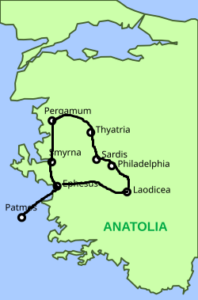
A forgotten Apostolic Missionary Journey?